
Funeral photo permissions should identify the image, the authority to use it and the places where it will appear. Confirm those points before sending a photograph to a printer, memorial-page provider or social channel. Keep the family’s choice of image and the copyright permission as distinct parts of the approval record.
This recommended workflow is for U.S. funeral-home teams preparing programs, slideshows and online memorial material. It explains a practical review process rather than resolving an individual copyright dispute. Ask counsel when ownership, an exception or another person’s rights are unclear; choosing an alternative image may be the simplest workable option.
What should funeral photo permissions cover?
The funeral home should list the intended uses in ordinary language: printed program, service slideshow, public memorial page or a particular social post. Ask the family to approve the selection and proposed presentation for each relevant use. Treat later advertising or an unrelated promotional post as a separate request, even if the image has already appeared in a memorial.
Create a simple record linking the original file to the approved uses, the person who supplied it and the evidence supporting permission. Record any credit requirement or limit. Avoid a vague note saying “photo approved” when it is unclear whether that means the family liked the crop, the rights holder authorized reproduction or both.
Who owns a photograph supplied by a family?
The U.S. Copyright Office explains that the person who takes a photograph generally owns its initial copyright, with limited work-made-for-hire exceptions. Copyright protection arises when an original photograph is fixed. Owning a print or appearing in the picture should not be treated as proof that someone owns the copyright.
Ask who took the photograph and whether there is a license or permission covering the proposed use. A professionally commissioned portrait may come with written terms worth checking. When a family cannot identify the photographer, do not invent an answer from the age of the print or the absence of a visible copyright notice. Pause for review or ask about another image.
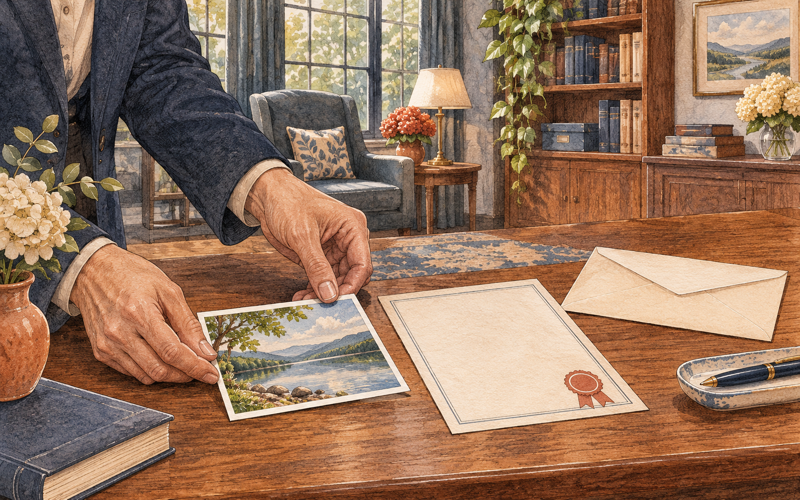
How should staff request and record permission?
As a recommended practice, describe the specific photograph and planned uses to the person authorized to grant permission. For example: “May we reproduce this image in the printed funeral program and on the public memorial page? Please tell us any credit or other conditions.” Adapt the request to the actual project; this sample is not a universal legal release.
Keep the response with the relevant file and note who reviewed it. If someone points to a license, retain the terms that support the intended use rather than only a screenshot of the photograph. Where a legal exception might apply, seek an appropriate assessment instead of treating a funeral setting or noncommercial purpose as automatic permission.
What should printers and memorial-page providers receive?
The funeral home should send the approved version and the instructions needed for that job. Specify any agreed crop, credit, placement and limits on reuse. Ask the provider who will publish the material and how corrections can be made. A file supplied for a printed program should not silently become material for the provider’s portfolio or advertising.
Before release, review the proof with the agreed family contact. Check the selected image, names, crop and destination together, then record approval of that version. If someone substitutes a different photograph after approval, repeat the relevant checks. A rushed replacement deserves the same attention as the first selection.
How should requests for changes be handled?
Give the family a clear way to request a correction or discuss removal. Identify which materials your team controls and which have already been distributed or published by another provider. Explain the next action and expected follow-up without promising that every printed copy or third-party copy can be retrieved.
If a rights question arises, pause any further planned use while the responsible manager reviews it. Preserve the original permission record and communicate with the relevant provider about practical next steps. Keep the discussion respectful: a family may have supplied a photograph in good faith without knowing what permission was needed.
Step by step
Put it to work this week
Adapt these recommended actions to your team, location and existing procedures.
Map the destinations
List the places your team routinely uses family photographs, including printed programs, online memorials and social posts.
- Who does it
- Office manager
- When
- This week
Create a permission record
Link each selected file to its source, intended uses, supporting permission or license and any conditions requiring review.
- Who does it
- Content coordinator
- When
- This week
Check the final proof
Confirm the image and destination with the agreed family contact before publication, and identify who handles corrections.
- Who does it
- Funeral director
- When
- This week
Questions professionals ask
- Does a family’s approval replace copyright permission?
Family approval confirms the selected image and intended presentation, but it does not by itself establish copyright ownership or a license. Identify the rights holder or another lawful basis for the planned use. Keep those checks alongside the family’s approval record.
- Can a photo approved for a program be used on social media?
Do not assume that approval or a license for a printed program covers a public social post. Check the scope of the permission and discuss that separate destination with the family. Record the approved use and any conditions before publishing.
- What if the photographer cannot be identified?
Keep the image on hold while the responsible person reviews the available evidence and any applicable legal basis. Do not guess ownership from the print’s age or missing credit. Ask the family about an alternative photograph if permission cannot be established in time.
Sources and references
These references support the guidance in this article. Each entry names the source and the date we checked it. Open the links for more detail, and confirm current requirements, availability, or costs with the relevant organization before relying on them.
- U.S. Copyright Office — What Photographers Should Know about Copyright · checked
copyright protection exists from the moment an original work is “fixed” in a tangible medium.