Start with one small, specific question and let it be a short conversation rather than a summit. Something like "If you ever got really sick, who would you want making decisions for you?" works better than "we need to talk about your will," because it asks about a person rather than about dying. The Conversation Project, a public engagement initiative of the Institute for Healthcare Improvement, builds its whole starter guide around this idea: think about what matters, plan the talk, start talking, keep talking. You are not trying to settle everything in one sitting.
You are trying to make the subject sayable, so that the second conversation is easier than the first.
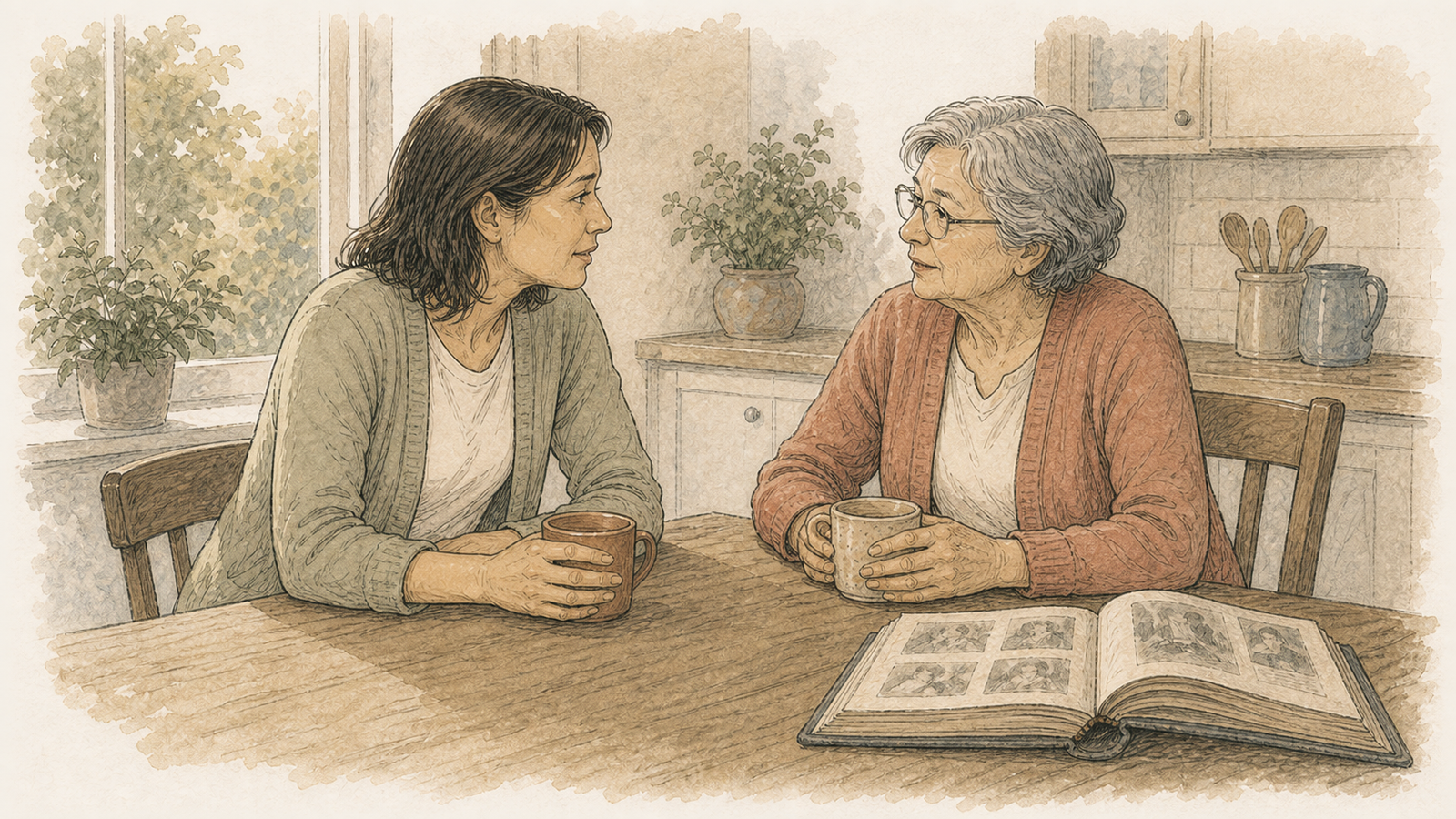
When should you bring it up?
Before anything is wrong. AARP puts it plainly in its caregiving guidance: have the talk in the kitchen rather than the intensive care unit.
The Conversation Project's 2018 national survey found that 92 percent of Americans think it is important to discuss their end-of-life care wishes, while only 32 percent have actually done so, and that gap is almost always closed in a hospital hallway under pressure. AARP's 2024 End of Life Survey found that 85 percent of adults over 45 say they are comfortable talking about death, yet seven in ten say the topic is generally avoided, which suggests the barrier is not willingness so much as nobody going first.
Useful openings show up on their own: a friend's illness, a hospital stay, a new diagnosis, a will being updated, a grandchild being born, or the drive home from a funeral.
What do you actually say first?
The Conversation Project's starter guide suggests borrowing a line rather than inventing one. "I need your help with something." "Will you help me think about my future?" "Even though I'm OK right now, I'm worried about what happens later, and I want to be prepared." Notice that all three make you the subject. Many adult children find the easiest entry is to fill out their own health care directive first and then ask a parent to look it over, which turns the conversation from an intervention into a favor.
The same guide recommends ordinary settings over formal ones: the kitchen table, a favorite restaurant, the car, a walk, or a phone call. Sitting side by side rather than across a table takes some of the weight out of it.
Then ask about values, not procedures. The Hospice Foundation of America suggests starting with "What do you value most about your life?" and letting the specifics about CPR, feeding tubes, and where someone wants to be come later. AARP uses a similar prompt: "What matters to me at the end of life is..." Your job in that first conversation is mostly to listen and remember, not to correct. If your mother says she never wants to end up in a nursing home, resist explaining why that may not be realistic.
Write down what she said in her own words. Those words are what a doctor will need later, and they are what you will need when you are the one deciding.
What if they shut the conversation down?
Expect it, and do not treat it as a refusal. The most common deflections are "I don't want to think about that," "your mother knows what I want," "we already have a will," and "there's nothing to leave anyway." Each has a short, honest answer. A will only speaks after death and does nothing about a hospital decision made next Tuesday. Knowing what someone wants is not the same as having the legal authority to say it.
And the paperwork here is about medical care, not money, so the size of an estate is beside the point. The Conversation Project's guidance on resistance is simple and worth following: be patient, some people need time to get ready to talk, and do not force everything into one conversation. If a parent says not now, ask when, and then come back at that time.

What documents should the conversation end in?
In Missouri, the two documents that matter are a Durable Power of Attorney for Health Care, which names the person who can speak for your parent, and a Health Care Directive, which describes what treatment they do and do not want. The Missouri Bar publishes a free combined form covering both.
Missouri treats the two differently at signing: the Durable Power of Attorney for Health Care must be signed in front of a notary public, while the health care declaration is signed in front of two adult witnesses and does not require notarization, according to the Center for Practical Bioethics, which tracks the witnessing rules for Missouri and Kansas. The Missouri Bar advises having the witnesses present when the form is signed before the notary, and choosing witnesses who are not related to your parent and not named in the document.
In Illinois, the equivalent documents are the Illinois Statutory Short Form Power of Attorney for Health Care and a living will covering death-delaying procedures. Under the Illinois Power of Attorney Act, the health care power of attorney needs the signature of one witness who is at least 18, and the statute states directly that there is no need to have the form notarized. The witness cannot be the agent, the attending physician, or a parent, sibling, spouse, or descendant of your parent or of the agent. The Illinois living will requires two witnesses.
The Illinois Department of Human Services publishes a plain-language Statement of Illinois Law on Advance Directives that walks through both, and it is a reasonable thing to print and hand across a table.
In Kansas, the two documents are the Declaration, commonly called a living will, and the Durable Power of Attorney for Health Care. Kansas Legal Services notes that the living will only takes effect once physicians confirm a terminal condition, while the durable power of attorney can take effect any time your parent cannot make decisions, which makes it the more useful of the two.
The Center for Practical Bioethics guide indicates that a Kansas advance directive is signed before two adult witnesses and does not have to be notarized, and that the Kansas Durable Power of Attorney for Health Care can be executed either before a notary or with two adult witnesses. In both Kansas and Missouri, a witness cannot be the named agent, a relative by blood or marriage, an heir, or someone financially responsible for your parent's medical care.
What happens if nothing gets signed?
This is the part most families get wrong, and it is different in each of the three states. Illinois has a Health Care Surrogate Act, which sets an order of decision makers when there is no directive: guardian of the person, then spouse, adult child, parent, adult sibling, adult grandchild, close friend, then guardian of the estate. Even then an Illinois surrogate cannot authorize withdrawal of life-sustaining treatment unless a physician has certified a qualifying condition. Missouri offers no such fallback.
The American Bar Association's Commission on Law and Aging lists Missouri as one of only four states with no default surrogate consent statute, and the ABA notes that Kansas's surrogate consent law applies only to medical research. In practice that means a Missouri or Kansas family with no signed power of attorney may need a court-appointed guardian to make decisions, which takes time, costs money, and, as Kansas Legal Services points out, can put a stranger in the room who has no idea what your parent wanted.
Keeping the plan current
Signing is not the end of it. The Hospice Foundation of America stresses telling the physician and the care team what was decided, and notes that states differ in how preferences must be recorded, so a document sitting in a drawer at home is close to useless. Give copies to the named agent, the alternate agent, the primary care doctor, and any hospital or facility involved.
Ask the doctor about the medical order that sits alongside the directive: Illinois uses the IDPH Uniform POLST form, signed by the patient or an authorized representative together with a practitioner, while Missouri and Kansas use the TPOPP/POLST form developed by the Center for Practical Bioethics in Kansas City, which Missouri law now recognizes as equivalent to an Outside the Hospital Do-Not-Resuscitate order. Revisit the whole set after any hospitalization, a new diagnosis, a move across state lines, or the death or divorce of a named agent.
One conversation rarely produces all of this, and it does not have to: ask the who question this month, the what-matters question next month, and bring the forms only after your parent has already said yes to the idea. PartingPoint can help you find the elder law attorneys, hospice programs, and advance care planning resources across Missouri, Illinois, and Kansas that turn those answers into signed paperwork.