Give copies of your healthcare directive and durable power of attorney for healthcare to your named agent, your primary care physician, and any hospital or facility that treats you; give your financial power of attorney to the agent you named and to your bank; and tell the person named as executor exactly where the original signed will is. The original will is the one document that should exist in exactly one place, and that place should be somewhere your executor can reach within days of your death without a court order.
Everything else in the folder works better as a copy in several hands than as an original nobody can find.
That distinction is the whole answer, and it is worth saying plainly. A photocopy of a healthcare directive or a power of attorney is generally honored the same as the signed original, which is why spreading copies around costs you nothing. A will is different: probate courts in Missouri, Illinois, and Kansas want the original signed instrument, and a missing original raises a legal presumption in most cases that the testator destroyed it on purpose. So the rule is copies everywhere for the medical and financial documents, one well-known location for the will, and a written note in your files telling people which is which.

Which documents does each person actually need?
Work down the list of people rather than the list of papers. Your healthcare agent needs the signed durable power of attorney for healthcare and your directive, and needs them now, not in a drawer they will search after you are already in an emergency room. Your financial agent needs the durable power of attorney for finances, and should confirm in advance that your bank will accept it, because banks routinely reject powers of attorney that are years old or drafted without their preferred language.
Whoever will make funeral decisions needs to know what authority they have: Missouri's right-of-sepulcher statute, RSMo 194.119, puts an attorney-in-fact holding a durable power of attorney that specifically grants the right of sepulcher ahead of the spouse and children, and puts a servicemember's DD Form 93 designee second, so if you have used either tool the funeral home needs to see the document within hours, not weeks. Your executor needs the location of the original will, an inventory of accounts, and enough information to reach your attorney.
Institutions need copies too, and a POLST or its regional equivalent belongs where paramedics will see it rather than in a file. Illinois uses the IDPH Uniform POLST form, and the Illinois Department of Public Health tells patients to keep it where they live and post a copy somewhere obvious such as the refrigerator, and confirms that photocopies of a valid form are followed.
Kansas and Missouri use TPOPP, the Transportable Physician Orders for Patient Preferences, developed by the Center for Practical Bioethics in Kansas City and now administered in Missouri through the Missouri State Medical Association. If you have a Missouri outside-the-hospital DNR instead, RSMo 190.603 requires the facility to keep it as the first page of your medical record and to send it with you when you transfer between facilities.
Is a safe deposit box a bad place to keep a will?
It is a common place and a poor one, and the reason is narrower than the folklore suggests. Banks in these three states do not seal a box the moment they learn of a death, but access contracts sharply.
Missouri's RSMo 362.488 lets the bank open a deceased renter's box in the presence of people claiming an interest in the contents, using two employees, one of whom must be an officer; anything appearing to be a will goes to the probate division of the circuit court, life insurance policies go to the named beneficiaries, cemetery deeds and burial instructions go to the person handling arrangements, and everything else stays put until someone with legal authority claims it.
Kansas does essentially the same under K.S.A. 9-1504, with a named executor permitted to take the will and the bank depositing it with the district court if no executor acts within sixty days.
Illinois works through the Safety Deposit Box Opening Act, 755 ILCS 15, which lets an interested person, meaning a deputy with access rights, a named executor, or a spouse, adult child, parent, or sibling, present proof of death and an affidavit and have the box opened, but only a document appearing to be a will, which goes to the circuit court clerk, and burial documents may be removed. Life insurance policies are not on the Illinois list. The practical problem in all three states is timing.
Cremation authorizations, veterans burial paperwork, and the choice between burial and cremation are settled in the first two or three days, and a branch that needs an officer, an affidavit, and a certified death certificate rarely moves that fast, particularly over a weekend. If you keep a box, name a joint lessee or deputy who is likely to outlive you, since a surviving joint renter keeps ordinary access, and keep the funeral instructions and the healthcare documents somewhere else entirely.
Can I file my will with the court before I die?
In Missouri, yes, and the option is underused. RSMo 474.510 allows a testator or an authorized agent to deposit a will with the probate division of any circuit court for safekeeping; the clerk seals it, labels the envelope with your name and the date, issues a certificate of deposit, and releases it during your lifetime only to you or to someone you authorize in writing.
On death the clerk notifies the person named on the envelope, and if nobody is named the will is opened publicly within thirty days. A statutory fee applies under the general court cost sections, so call your county's probate division for the current amount. Illinois and Kansas have no equivalent general provision.
Illinois's only statewide lifetime deposit route is 15 ILCS 305/5.15, which lets an attorney deposit a client's original will with the Secretary of State when the client cannot be located after diligent search; the sealed envelope is not a public record, though the alphabetical index of testators is, and once a death is proven the Secretary sends the will to the circuit court clerk. Kansas's probate code, where the old section 59-620 has been repealed, provides only for filing a decedent's will under K.S.A. 59-618a.
In those two states the realistic alternatives are your attorney's fireproof storage or a home fire safe your executor can open.
How long does my family have to file the will after I die?
Each state imposes a duty on whoever holds the will, and each deadline is different, so verify the one that applies to you rather than borrowing a neighbor state's.
In Missouri, RSMo 473.043 says the person having custody of the will shall deliver it to the probate division after death, and the court may compel production by attachment; separately, RSMo 473.050 bars a will from probate entirely if it is not presented within one year of death when no letters have been granted, or within six months of first publication of notice of letters when they have.
In Illinois, 755 ILCS 5/6-1 requires the custodian to file the will with the clerk of the court immediately upon death, and willfully secreting it for more than thirty days after learning of the death, or altering or destroying it, is a Class 3 felony.
In Kansas, K.S.A. 59-618 requires anyone possessing or knowing of a will to produce it to the district court within six months of death and makes a wrongful withholder liable for the beneficiaries' damages and attorney fees, while K.S.A. 59-617 independently bars probate unless a petition is filed within six months of death, with a narrow ninety-day window for a beneficiary who genuinely did not know the will existed. Missouri's one year and Kansas's six months are outer limits, not targets.
Where do hospitals actually keep an advance directive?
In your chart, and only if someone hands it to them. Under the federal Patient Self-Determination Act, hospitals, nursing homes, hospice programs, and home health agencies that take Medicare or Medicaid must ask on admission whether you have an advance directive and document the answer, but the obligation stops at asking. If you say yes and produce nothing, the chart records that you have one and the treating team has no idea what it says.
Bring the paper, ask for it to be scanned into the record, and ask whether it should also be uploaded to the health system's patient portal, since a directive filed with one hospital in St. Louis is not visible to a different system in Springfield or Wichita. None of the three states maintains a state advance directive registry, unlike Vermont, Washington, Nevada, and Virginia.
The Missouri Bar's guidance on its free durable power of attorney for healthcare form says to give copies to your agent, your physician, and any other healthcare provider, and Kansas State University Research and Extension's guide to the Kansas form adds the useful suggestion of a note in your wallet saying where the original lives.
What about passwords and online accounts?
Digital access runs through its own legal channel, and it outranks your will. All three states have adopted the Revised Uniform Fiduciary Access to Digital Assets Act: Illinois at 755 ILCS 70, Kansas at K.S.A. 58-4801 and following, and Missouri as the Missouri Fiduciary Access to Digital Assets Act at RSMo 472.400 through 472.490, effective in 2018.
Section 4 of the Illinois act states the rule the others share, that a direction given through a provider's online tool overrides a contrary direction in a will, trust, power of attorney, or other record, provided the tool lets you change it at any time. In practice the twenty minutes you spend setting an Apple legacy contact, a Google Inactive Account Manager plan, and a Facebook legacy contact accomplishes more than a paragraph in your will.
Behind those, use a password manager with an emergency access feature, name the same person you named as executor, and write the master password on paper stored with the will rather than inside the manager. Do not list passwords in the will itself: once admitted to probate, a will becomes a public court record.
What should the paper folder actually contain?
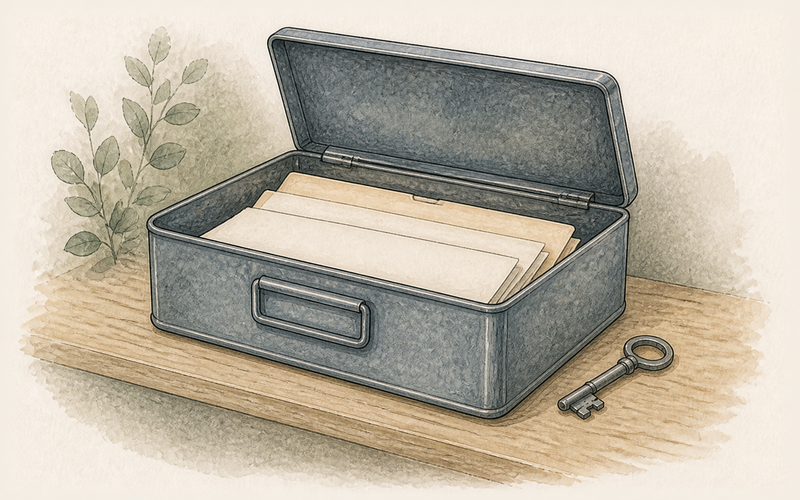
One folder, in a fireproof box at home, plus a duplicate copy set with the person most likely to need it.
Include the original will if you have not deposited it with a Missouri probate division or left it with your attorney, signed originals or clear copies of both powers of attorney and the healthcare directive, the deed to your house, vehicle titles, the cemetery plot deed, any preneed or prepaid funeral contract with the seller's name and contract number, life insurance policies with the insurer's claims phone number, a one-page inventory of banks, brokerages, retirement accounts, and debts, and your DD-214 if you served.
That last one is worth doing properly: recorders of deeds in Missouri and Illinois and registers of deeds in Kansas record military discharges at no charge, and the recording is a closed record released only to the veteran, a surviving spouse, and certain others defined by statute, as the St. Louis Recorder of Deeds and the Douglas County, Kansas, Register of Deeds both explain. A recorded DD-214 means a funeral home can prove service for a VA burial allowance or a national cemetery interment on a weekend when the National Personnel Records Center is closed.
Review the folder once a year on a date you will remember, and again after any move, divorce, death of a named agent, or change of bank, and re-sign a financial power of attorney that has gone stale. Tell the three or four people named in these documents where the folder is and what is in it, because a plan nobody knows about is indistinguishable from no plan.
PartingPoint can help you find an estate planning attorney, a probate attorney, or a funeral provider in Missouri, Illinois, or Kansas when you are ready to put these documents in place, or to act on the ones already signed.
Sources and references
These references support the guidance in this article. Each entry names the source and the date we checked it. Open the links for more detail, and confirm current requirements, availability, or costs with the relevant organization before relying on them.
- Missouri — right of sepulcher (RSMo 194.119) · checked
the right to choose and control the burial, cremation, or other final disposition of a dead human body
- Missouri — outside the hospital do-not-resuscitate order (RSMo 190.603) · checked
A patient or patient's representative and the patient's attending physician may execute an outside the hospital do-not-resuscitate order.
- Missouri — opening a safe deposit box after death (RSMo 362.488) · checked
in the presence of persons claiming to be interested in the contents thereof, by two employees of the lessor, one of whom shall be an officer
- Kansas — opening a safe deposit box after death (K.S.A. 9-1504) · checked
in the presence of persons holding a legal or beneficial interest relating to the lessee, by two employees of the lessor, one of whom shall be an officer
- Illinois Safety Deposit Box Opening Act (755 ILCS 15) · checked
This Act may be cited as the Safety Deposit Box Opening Act.
- Missouri — depositing a will with the court in your lifetime (RSMo 474.510) · checked
A will may be deposited by the person making it, or by such person's agent, with the probate division of any circuit court, to be safely kept
- Illinois Secretary of State Act — deposit of wills (15 ILCS 305/5.15) · checked
A depositor may deposit a will with the Secretary of State if the depositor certifies in writing to the Secretary of State that the depositor is unable to locate the testator after a diligent search.
- Kansas — filing certain wills or copies in court (K.S.A. 59-618a) · checked
Filing of certain wills or copies in court; affidavit; admission to probate
- Missouri — delivery of a will after death (RSMo 473.043) · checked
After the death of the testator, the person having custody of his will shall deliver it to the probate division of the circuit court which has jurisdiction of the estate
- Missouri — presenting a will for probate (RSMo 473.050) · checked
A will not presented for probate within the time limitations...is forever barred from admission to probate in this state.
- Illinois Probate Act — duty to file the will (755 ILCS 5/6-1) · checked
Immediately upon the death of the testator any person who has the testator's will in his possession shall file it with the clerk of the court of the proper county
- Kansas — liability for withholding a will (K.S.A. 59-618) · checked
knowingly withholds it from the district court having jurisdiction to probate it for more than six months after the death of the testator shall be liable for reasonable attorney fees, costs and all damages
- Kansas — will ineffective unless probated within six months (K.S.A. 59-617) · checked
No will of a testator who died while a resident of this state shall be effectual to pass property unless a petition is filed for the probate of such will within six months after the death of the testator
- Illinois Revised Uniform Fiduciary Access to Digital Assets Act (755 ILCS 70) · checked
This Act may be cited as the Revised Uniform Fiduciary Access to Digital Assets Act (2015).
- Kansas Revised Uniform Fiduciary Access to Digital Assets Act (K.S.A. 58-4801) · checked
This act may be cited as the revised uniform fiduciary access to digital assets act (2015).
- Missouri Fiduciary Access to Digital Assets Act (RSMo 472.400) · checked
Sections 472.400 to 472.490 shall be known and may be cited as the 'Missouri Fiduciary Access to Digital Assets Act'.