When you start calling funeral homes about cremation, you may notice something confusing right away: the same word covers two very different purchases. One provider quotes a figure in the thousands, another quotes a fraction of that, and both are describing cremation. Understanding the difference between direct cremation and cremation with services is the single most useful thing you can learn before you compare prices, and it takes about five minutes.
What is direct cremation?
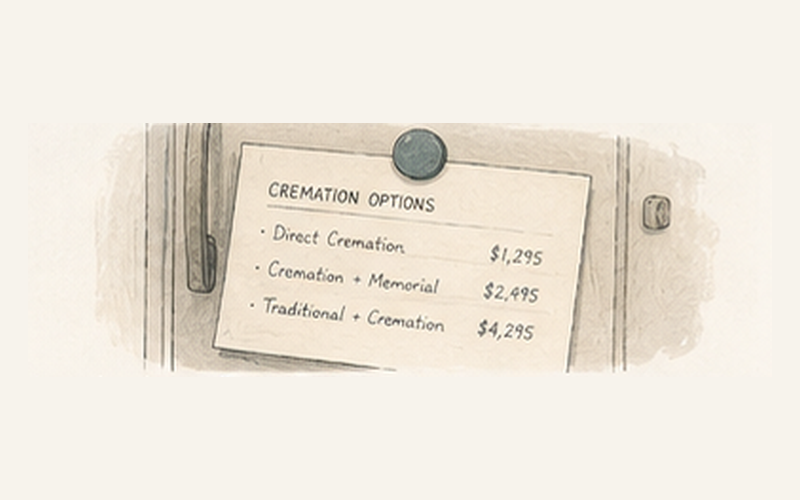
Direct cremation is the simplest option a funeral home offers. The person who died is brought into the funeral home's care, held in refrigeration until paperwork is complete, cremated in a plain combustible container, and the ashes are returned to you. There is no embalming, no viewing, and no ceremony arranged through the funeral home. A direct cremation price typically covers the transfer from the place of death, sheltering or refrigeration, the crematory fee, a basic cremation container, and the filing of the death certificate. Certified copies of the death certificate are usually billed separately at whatever your county's vital records office charges, so ask how many copies are included, if any.
What is cremation with services?
Cremation with services means the funeral home also arranges some combination of embalming, a visitation or viewing, a ceremony, staff, facilities, and often a rental casket, with cremation as the final disposition. This is why the numbers diverge so sharply. The National Funeral Directors Association's 2023 General Price List study — still the most recent as of September 2026 — put the median cost of a funeral with cremation at $6,280, compared with $8,300 for a funeral with casket and burial. Neither figure includes cemetery costs, a grave marker, or cash advances. Neither figure includes a cemetery plot, marker, or niche.
How much does direct cremation cost?
Direct cremation sits well below that. The commercial price-comparison service Funeralocity has reported a national average of about $2,183 for direct cremation — a trade figure, not official data, since no government body publishes a direct cremation average — and prices in many communities run both above and below that figure. In Missouri, as elsewhere, what you actually pay depends on the individual provider, which is why the next point matters so much.
Why do cremation prices vary so much in one town?
Two funeral homes a mile apart can charge dramatically different prices for the identical direct cremation. The service is the same; the businesses are not. One may own its crematory while another pays a third party. One may carry the overhead of a large chapel, a fleet of vehicles, and corporate ownership, while another runs lean out of a modest storefront. None of that changes what happens to the person who died, but all of it shows up in the price. Under the Federal Trade Commission's Funeral Rule, every funeral home must give you prices over the phone and hand you an itemized General Price List when you visit in person, so comparing three or four providers is both legal and reasonable, and no one should make you feel otherwise for asking.
What is a cremation society?
You may also come across cremation societies, which despite the name are usually businesses rather than clubs. Many use a membership model: you pay a modest one-time enrollment fee, often while preplanning, and in exchange you lock in a discounted direct cremation price. These can be a fair value, but read the agreement the way you would any contract. Ask what happens if the person dies outside the service area, whether the price is truly guaranteed or only discounted, and whether the fee is refundable.
Do you have to buy the urn from the funeral home?
Urns are a place where families often overspend at a hard moment. The Funeral Rule gives you the right to supply your own urn or container from anywhere, and the funeral home must accept it without charging you a handling fee. The ashes will otherwise come back to you in a simple, sturdy container that is perfectly adequate, especially if you plan to scatter. A meaningful vessel from home, a wooden box a family member makes, or an urn purchased online all work just as well as one from the funeral home's display room.
What can you do with the ashes in Missouri?
Once the ashes are home, you have time, and there is no deadline for deciding. Missouri families commonly scatter on private land with the owner's permission, and for public parks, waterways, or conservation land it is wise to check with the managing agency first, since policies vary. Federal rules permit scattering at sea at least three nautical miles from shore. You can also inter ashes in a cemetery plot or columbarium niche, divide them among family members, or simply keep them. In Missouri, the person with legal authority to arrange cremation follows the state's right-of-sepulcher order of priority among next of kin, and cremation cannot proceed until the death certificate paperwork is properly filed, which is part of why there is always a short wait.
Three questions to ask before you choose
Before you choose any provider, ask three questions and listen for clear, unhurried answers. How do you track chain of custody from transfer through the return of the ashes, and may we have an identification viewing before cremation? Is your crematory on-site, or do you use a third party, and if so, who? And how long will the whole process take, from the day you take someone into your care to the day the ashes are back in ours? A provider who answers these plainly, and shows you prices in writing without being pressed, is telling you something about how they will treat your family.
Sources and references
These references support the guidance in this article. Each entry names the source and the date we checked it. Open the links for more detail, and confirm current requirements, availability, or costs with the relevant organization before relying on them.
- NFDA — 2023 General Price List Study (news release, 8 December 2023) · checked
the median cost of a funeral with casket and burial has increased only 5.8% over the past two years (from $7,848 to $8,300) ... The cost does not take into account interment in a cemetery, monument or grave marker costs, or cash-advance charges.
- FTC — The Funeral Rule (consumer guidance) · checked
Funeral directors must give you price information on the telephone if you ask for it. You don't have to give them your name, address, or telephone number first.